

The aim of the Design + Technology program at EIS is to help students develop the four Cs of the 21st century: critical thinking, communication, collaboration, and creativity.
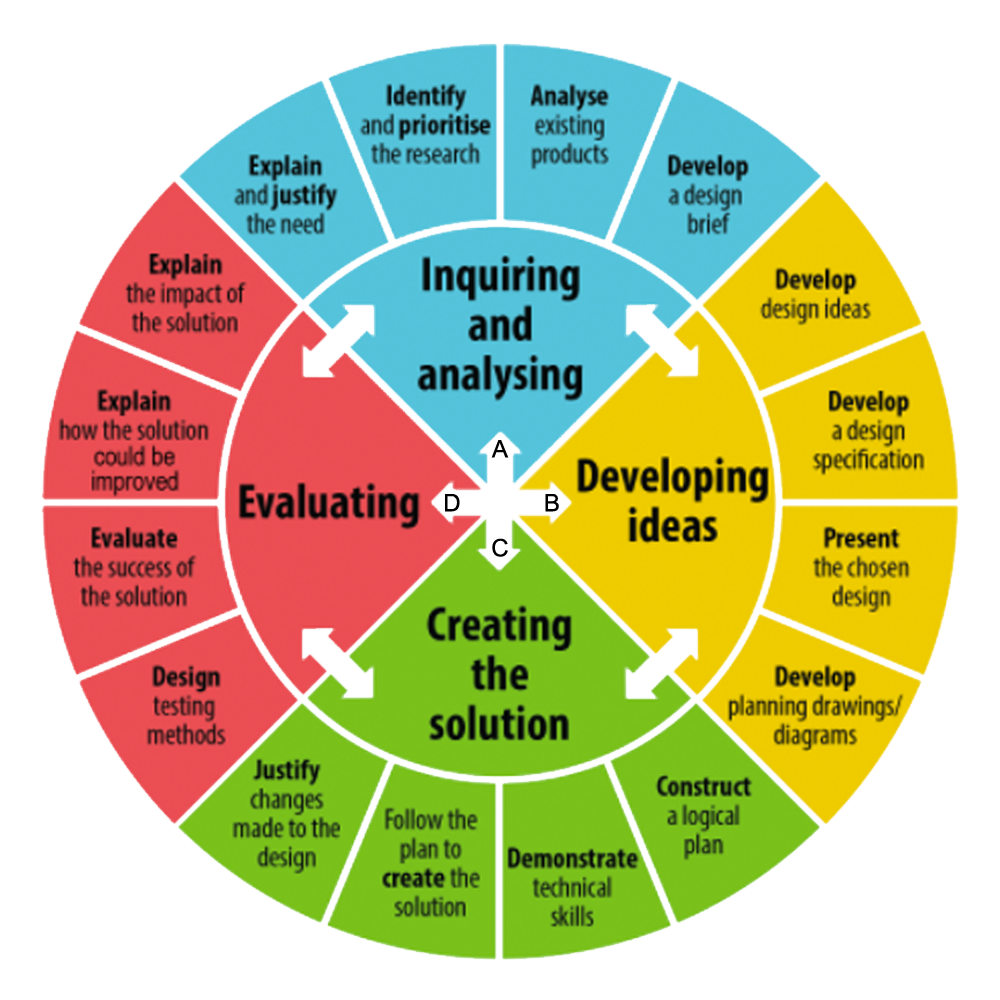
Mastering these competences would provide students with a robust foundation to conquer an ever-changing world. This is enabled by introducing the student with the MYP design cycle which covers different conceptual concepts by diving into the 4 criterias; Inquiring and analyzing, Developing Ideas, Creating the Solution and Evaluating.
Educational programs world-wide have been integrating computer programming in all levels of school curricula, but only a few schools offer a fully integrated Design and Technology program that not only teaches computer programming skills but also the entirety of the design cycle of a brand and product.
While Information Technology education indeed provides students with essential computer skills, it is also vital in developing what is referred to as “computational thinking”:
a problem-solving approach that is rigorously structured and based on problem decomposition, pattern recognition, abstraction, and algorithmic thinking.
This asset is what makes the Design and Technology education – particularly coding – integral for student development. We strive to help students effectively (and confidently) utilize optimized ways of thinking – be it academically or professionally. But we at EIS believe that students should develop an appreciation to the elegance and power of the design process while appreciating past, present and emerging designs within global contexts. Under the design and technology program, students develop knowledge and the required skilled from different disciplines to design and create real world solutions to problems by using technology effectively.
Because current pedagogical trends of the field are constantly changing, we, at EIS, are also adapting to all new technologies. Students at EIS end up gaining the knowledge and skills and attitudes from the design courses for careers in industrial, multimedia, product design , video and game development, architecture and roles in engineering, manufacturing and advertising.
About the program
-
The Design and Technology program at EIS provides a progression of learning from IB Primary Years Programme (PYP) to IB Diploma Programme (DP). In the PYP, teaching and learning experiences challenge students to be curious, ask questions, explore and interact with the environment physically, socially, and intellectually to construct meaning and refine their understanding. Even when there is no design component in the PYP, the use of structured inquiry is a precursor to the problem-solving and inquiry-based approach of Middle Years Program (MYP) design. MYP design aims to build on what students learn and do in the PYP and other student-centred programmes of primary education.
MYP design courses help specifically to prepare students for the study of computer science, design technology and information technology in a global society (ITGS) in the Diploma Programme (DP). -
• COMPUTER SCIENCE requires an understanding of the fundamental concepts of computational thinking, as well as knowledge of how computers and other digital devices operate.
• DESIGN TECHNOLOGY aims to develop a high level of design literacy by enabling students to develop critical- thinking and design skills, which they can apply in a practical context.
• ITGS is the study and evaluation of the impacts of information technology (IT) on individuals and society.
Throughout all stages of the program, students are encouraged to think independently, creatively, and innovatively. -
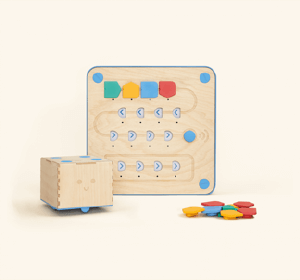
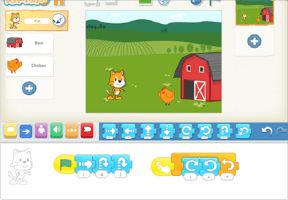
• IN THE PRIMARY YEARS PROGRAMME, students begin their coding adventure with off screen coding with Cubetto, an educational robot for young kids. The way Cubetto works is by having children “program” using a series of colorful “coding blocks” onto the wooden board that uses light signals and sounds to highlight the success of the code. Moving on within PYP, early learners on iPads will be exposed to an educational programming language (e.g. ScratchJr) that offers a visual and interactive enviroment. Students are expected to manipulate "programing blocks" to develop their own games and stories. At EIS, we recognize that early learners are being exposed to technology at a young age, which is why we reinforce every year screen netiquette and the importance of being a good digital citizen. Students will understand what internet security is and how to safely browse the world wide web. Early Years learners will also learn to be young film makers, using iStopMotion to create an animation.
-
• AT ONLY THE AGE OF 7 YEARS OLD, our students will be taught about the world of Virtual Reality as they create their own virtual space that will help them understand the concept of space and navigation. The curriculum will then expose students to 3D printing; students will grasp the concept of product design by taking precise measurements and designing a solution to a real world problem. Learners will also explore solar cells by building their own electric circuit using an Arduino board. To better prepare these young learners for the MYP curriculum, PYP learners are exposed to branding using Adobe Photoshop software. Students will learn about logos and their specifications to further then develop their own logos. Students will develop their understanding further by learning about and producing their own commercials, using the film and editing application iMovie. During the Middle Years Programme, students will be using a more advanced editing program, Adobe Premiere Pro.
-
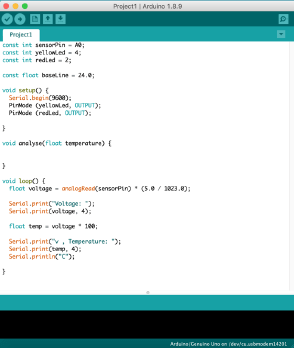
• PROGRAMMING LANGUAGES: Students then delve into the world of software development with programming languages that have been specifically tailored for educational purposes (e.g., HTML and Javascript). Such languages are based on what is referred to as “turtle graphics”, where students program the movement of an on-screen turtle by visualizing themselves in motion. Referred to as "body-syntonic reasoning", this process offers a unique interactive environment that enables students to get a feel of coding by “seeing” what they are thinking (Murgante et al., 2014). Moreover, students are also introduced to the structure, logic, design, and syntax of programming. For example, they will learn how to break down a complex problem, recognize good coding practices from bad ones, use coding comments effectively, and understand human-computer interaction throuh inputs and outputs.
-
• ONCE STUDENTS COVER THE BASICS OF PROGRAMMING WITH EDUCATIONAL SOFTWARE, they move on to learn a more advanced language in DP: Python. Used by top-tier organizations such as NASA, Google, and Netflix to name a few, this language is deemed as “the programming language of the future”. As opposed to other programming languages (e.g C++), Python offers a more human-friendly syntax. The language may be used in diverse fields such as data analytics, networking, machine learning, artificial intelligence, and robotics. At this stage, high school students will use Python to further develop their coding, problem-solving, and analytical skills. The effectiveness and efficiency of the program could be further improved by integrating it with areas of the curriculem (e.g. math and music). This would help students develop a better grasp on both areas of the curriculum.

Finally, it is also important to apply the knowledge gained from software development into real-world experiments. The final part of the program makes use of gained skills and offers three different specialized tracks for students: software development (incl. games), robotics, and digital arts.
These tracks are tailored for the diverse interests of students – while some would look forward to programming robots, others would prefer to make use of coding skills for artistic purposes. The aim is to provide a space where students use programming knowledge to explore their interests in hands-on applications, all the while strengthening both hard and soft skills. Students are expected to work in teams to deliver a final-year project that encapsulates the learning objectives of the program. Students may choose to work on a variety of projects ranging from coding musical instruments to developing program. Students may choose to work on a variety of projects ranging from coding musical instruments to developing virtual assistants.
Our standing on both a national and international level:
why choose Eastwood for your children?
On a national level, the Lebanese curriculum (as set by the Ministry of Education and Higher Education) does not require computer education – let alone coding. However, several schools have incorporated Design and Technology (with and without coding) in their curricula.
Due to the lack of available data, there is no structured approach to Design and Technology education in the country. While this may be due to a lack of awareness, funds, or expertise, it is still the duty of schools to equip students with the necessary skills. However, several private training centers are offering exactly that; they provide after-school coding sessions for students of all levels.
In countries with high rates of unemployment (e.g., Lebanon), it is very common to find equally high numbers of unfilled positions in the technical and digital services (Peñalvo & Cruz-Benito, 2016). Therefore, it is vital to bridge the skills gap between the labor market and employee availability. The Design and Technology program at EIS could encourage other schools and organizations to adopt similar programs – which would constructively drive the country’s economy forward.
On an international level, countries around the world have been re-structuring their educational curricula to include coding classes. For example, the European Union Erasmus+ program has developed Taccle3, a program that encourages primary school teachers to teach coding by offering them necessary resources and support. Numerous countries have also been integrating ICT as a compulsory subject in K-12 curricula (e.g., the UK, Australia, New Zealand) (Webb et al., 2017). While each of these countries has developed distinct teaching approaches to target students of different age groups, the common major challenge in pedagogical experiences so far is the need for teacher professional development (Webb et al., 2017). Finally, it is important to note that engaging girls in Design and Technology would decrease the gender gap in the male-dominated STEM fields both nationally and internationally.
Moreover, several local coding competitions are held for high-school students. For example, the Lebanese American University, in collaboration with Tides Foundation, held a “Game Coding Competition for High Schools.” One of the main missions of the competition was to provide professional development for high school teachers who coached groups of students (Lebanese American University, 2017). Rafik Hariri University also holds an annual High School Programming Contest, and offers a two-months training session for all participants (Rafik Hariri University, 2017). This may encourage students to make the most out of their Design and Technology education and partake in such competitions.


Academic
Excellence
The importance of teaching coding skills to students is quite self-evident.
Whether it is about college readiness or the professional world, being tech-savvy
is no longer a plus but a necessity.
That is, Design and Technology education is no longer only relevant for students who decide to embark on a relevant career path (e.g., computer engineering). Indeed, a student who wishes to indulge in a “creative” domain such as the digital arts is also expected to master necessary computer software (Adobe Illustrator and Adobe Photoshop). Even if a student decides to embark on a career in the social sciences, they are also expected to utilize statistical computing in similar coding environments (e.g., R programming language).
However, the objective of the program at EIS is not only about equipping students with practical skills. Most evidently, the program provides a space for critical thinking and creative problem-solving skills that are quite different from those attained in other areas of the curriculum.
It is about nurturing the aforementioned “computational thinking,” to provide students with the ability to efficiently and effectively tackle problems. As such, this way of thinking is not restricted to STEM fields alone, as it offers distinct and vital cognitive tools. From a non-cognitive perspective, significant correlations have been found between computational thinking and openness to experience, extraversion, and conscientiousness (Román-González et al., 2016).
One of the less-known takeaways from learning coding is the ability to understand the ethical issues around it. The biggest ethical dilemmas in our age pertain to information privacy, artificial intelligence, robots, and so forth. Therefore, when students are exposed to such terms, they would be able to constructively build their own perspectives. Computational thinking is also relevant in this case, as it is found to be “particularly suited to decision making in moral dilemmas” (p.14): it helps students realize that there are no “right” and “wrong” answers – but rather a need to diminish unwanted consequences (García-Peñalvo & Cruz-Benito, 2016).
References
Bell, T. (2016). Demystifying coding for schools—what are we actually trying to teach? Bulletin of EATCS, 3(120).
García-Peñalvo, F. J., & Cruz-Benito, J. (2016). Computational thinking in pre-university education. In Proceedings of the Fourth International Conference on Technological Ecosystems for Enhancing Multiculturality (pp. 13-17). ACM.
Lebanese American University. (2017). LAU Supports computer science education through gaming coding competition. Retrieved from: https://www.lau.edu.lb/news-events/news/archive/one_step_at_a_time_lau_support/
Murgante, B., Misra, S., Rocha, A. M. A. C., Torre, C.,Rocha, J. G., Falcão, M. I., ... & Gervasi, O. (Eds.). (2014). Computational Science and Its Applications-ICCSA 2014: 14th International Conference, Guimarães, Portugal, June 30-July 3, 204, Proceedings (Vol. 8583). Springer.
MYP Design Guide. (2014). International Baccalaureate Middle Years Programme Design guide. Retrieved from: https://resources.ibo.org/
Rafik Hariri University. (2017). High School Programming Contest. Retrieved from: https://www.rhu.edu.lb/media-room/events/high-school-programming-contest
Román-González, M., Pérez-González, J.-C., Moreno-León, J., and Robles, G. (2016). Does computational thinking correlate with personality? The non-cognitive side of computational thinking. In Proceedings of the Fourth International Conference on Technological Ecosystems for Enhancing Multiculturality (TEEM’16) (Salamanca, Spain, November 2-4, 2016), F.J. García-Peñalvo Ed. ACM, New York, NY, USA.
Webb, M., Davis, N., Bell, T., Katz, Y. J., Reynolds, N., Chambers, D. P., & Sysło, M. M. (2017). Computer science in K-12 school curricula of the 2lst century: Why, what and when? Education and Information Technologies, 22(2), 445-468.
FAQs
Would the Design and Technology program at EIS guarantee a STEM career for my child?
The aim of the program is to prepare students for the digital world. More importantly, the program also nurtures “computational thinking” that helps students in numerous domains – including but not restricted to – STEM. While students will be exposed to a wide range of Design and Technology topics, this does not guarantee a job or a university placement.
Would the program interfere with my child’s educational program (e.g. IBDP)?
The program does not aim to overwhelm students with “difficult” Design and Technology topics. Indeed, several topics covered by educational curricula (be it the Lebanese Baccalaureate or IBDP) will be integrated with Design and Technology classes. In that way, students would get a better understanding of both subjects (e.g. using principles learned in mathematics classes in coding).
I have never received Design and Technology education; how would I be able to help my child?
The program will be delivered in a way that ensures all students grasp the necessary material in class. In the case where the student is facing difficulty solving homework, it is optimal if the student reaches out to classmates or instructors during school hours.